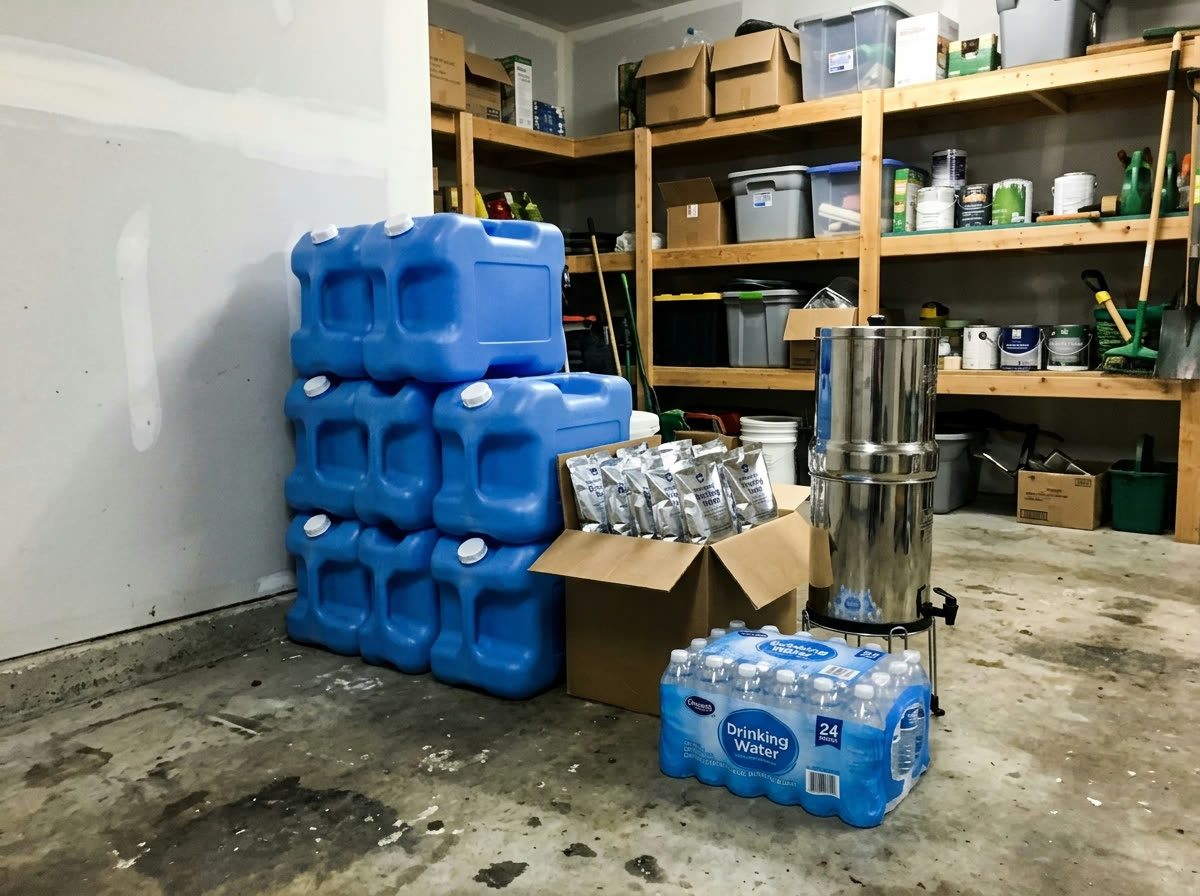
The first time we tried to estimate how much water our household would actually need in an emergency, we guessed low. Way low. We pictured a few cases of bottled water in the garage and figured we'd be fine. Then the power went out for three days during an ice storm, the pump on our well stopped, and we watched our "plenty" disappear by the second afternoon between drinking, cooking, and washing hands.
Water is the part of preparedness people most often underestimate, and it's the one you can least afford to get wrong. You can ration food for a surprisingly long time. You cannot ration water the same way without getting sick, foggy, and miserable fast. So this is the system we landed on after doing it badly once: a concrete number, a place to put it, a schedule to keep it fresh, and a plan for turning questionable water into safe water when the stored supply runs thin.
We're going to do the actual math here, because "store some water" is useless advice. We'll cover how much a family of four needs for two weeks, the trade-offs between bottled water, stored tap water, and filtration, and a simple tiered plan you can build over a few paychecks instead of one overwhelming weekend.
How much water you actually need
The standard planning figure most preparedness guidance uses is about one gallon per person per day. Roughly half of that is for drinking, and the other half covers cooking, basic hygiene, brushing teeth, and washing hands and dishes. That's a planning baseline, not a hard floor: in heat, at altitude, or with anyone pregnant, nursing, or sick, real consumption climbs.
Let's do the math for a family of four over two weeks:
- 4 people × 1 gallon × 14 days = 56 gallons
- That's about 28 gallons for drinking and 28 for hygiene and cooking
- In standard cases of bottled water (roughly 2.8 gallons each), 56 gallons is about 20 cases
- In 5-gallon jugs, it's roughly 11 to 12 jugs
Fifty-six gallons sounds like a lot until you see it stacked in a corner. We keep a rounded figure of about 60 gallons in mind to leave a little margin, because a few gallons always seem to get used on something we didn't plan for.
Honest caveat: two weeks is a reasonable target for most families, and a meaningful step up from the bare-minimum three-day kit. But it's a starting line, not a finish line. If you live somewhere prone to long outages, scaling toward a month is worth doing once your two-week base is solid.
Store-bought, stored tap, or filtration: the honest trade-offs
There are three ways to have water on hand, and the right answer is usually all three in layers rather than betting everything on one.
Commercial bottled water
Sealed bottled water is the easiest and most reliable option. It's pre-purified, stores for a long time, and there's nothing to do but buy it and stack it. We treat it as our "grab and go" tier and our first few days of supply. The downsides are cost, the space all that packaging eats up, and plastic waste if you rotate aggressively.
Stored tap water
If your tap water comes from a treated municipal supply, you can store it yourself for far less money using clean, food-grade containers like stackable 5-gallon water jugs. This is the cheapest way to hit a big number like 56 gallons. Fill from the tap, seal tightly, label with the date, and keep it cool and dark.
Honest caveat: stored tap water is only as good as the container and the source. Never reuse old milk jugs — the residual sugars and proteins are nearly impossible to fully clean and will grow bacteria. Use containers made for water or food, and if you're storing well water or anything untreated, treat it before storage rather than trusting it.
Filtration and purification as a backstop
Stored water is finite. Filtration extends your supply past whatever you set aside, by letting you make use of rain, a stream, a pool, or a water heater tank. A countertop gravity water filter is the workhorse for at-home use, and a smaller pump or squeeze filter covers you if you have to leave. We think of filtration not as a replacement for stored water but as the safety net underneath it.
The mistake we made early on was treating these three options as competitors. They're not. Bottled water buys you time, stored tap water buys you volume, and filtration buys you longevity. You want all three working together, not one carrying the whole load.
Where to store it and how often to rotate
Water wants three things in storage: cool, dark, and off bare concrete. Heat and light degrade containers and encourage growth, and storing plastic directly on a concrete floor can, over time, let odors leach in. A few inches of clearance on a pallet or shelf solves that.
We spread our supply across more than one spot — some in a basement corner, some in a closet, a couple of cases in the vehicle — so no single problem (a flooded basement, a locked-out house) wipes out the whole stash. Distributing it also makes the weight easier to live with, since 56 gallons runs well over 450 pounds.
On rotation: rotate stored water every 6 to 12 months. Commercial sealed bottles last longer and carry their own dates, but homemade stored tap water should be refreshed at least annually. We tie ours to the clock-change weekends in spring and fall — same trick as smoke-detector batteries — so it's a calendar habit instead of a thing we forget.
Honest caveat: properly stored water doesn't really "expire" so much as it can pick up flavors and, if a seal fails, contamination. If stored water ever looks cloudy, smells off, or has anything growing in it, don't drink it — run it through your filter and purification step, or discard it.
Turning questionable water into safe water
At some point the stored supply may run low and you'll be looking at water of unknown quality — a stream, a rain barrel, a pool. Here's the rule we never break: never assume tap or stream water is safe without both filtering and purifying it. Filtering removes what you can see and much of what you can't; purifying kills the microorganisms a filter alone may miss. They do different jobs.
Filtering
Filtering means physically straining the water. Pre-strain visibly dirty water through a cloth or coffee filter first to pull out sediment, then run it through a real filter rated for microbiological contaminants. A good gravity or pump filter handles bacteria and protozoa like the ones that cause most waterborne illness. Filters generally do not remove viruses or chemicals, which is why filtering alone isn't the finish line.
Boiling
Boiling is the most reliable purification method and needs no special gear beyond a heat source. A rolling boil for one minute (longer at high altitude) handles bacteria, viruses, and protozoa. The catch is fuel: boiling a lot of water burns through propane or wood fast. We use it as our gold standard when we can spare the fuel.
Purification tablets
Water purification tablets are our lightweight backstop. They're cheap, store for years, and require no fuel — you just dose, wait the specified time, and drink. They're ideal for a go-bag and for treating filtered water when boiling isn't practical. The downsides are a slight taste and a wait time, and they work best on water that's already been filtered clear.
UV purification
A battery or USB UV purifier disrupts microorganisms quickly and leaves no taste — a slick option for small batches of already-clear water. Honest caveat: UV depends on batteries and on the water being clear; it does nothing for cloudy water and stops working when the power's dead, so we'd never make it our only method.
A simple tiered plan you can actually build
Here's how we'd assemble the whole thing without it feeling overwhelming. Build it in tiers, in order:
- Tier 1 — immediate (a few days): commercial bottled water you can grab instantly. No prep, no treatment, just drink. This covers the chaotic first 72 hours.
- Tier 2 — bulk volume (the bulk of two weeks): stored tap water in 5-gallon jugs to reach your ~56-gallon target affordably. Labeled, dated, rotated every 6 to 12 months.
- Tier 3 — the backstop (open-ended): a countertop gravity filter plus purification tablets, so that when stored water runs out you can safely process questionable sources for as long as you need to.
The beauty of tiers is that any one of them is useful on its own, and you can buy them over time. Start with a few cases of bottled water this week, add jugs over the next month or two, and bring the filter and tablets in once your stored volume is solid.
Water is the least glamorous part of being prepared and the one we'd protect first. Do the math once — about 56 gallons for a family of four over two weeks — put it somewhere cool and dark, set a twice-a-year reminder to rotate it, and keep a filter and a bottle of tablets as your safety net. None of it is expensive or complicated when you build it in layers. The hard part is just starting, and the easiest way to start is to buy more drinking water than you think you need the very next time you're at the store.