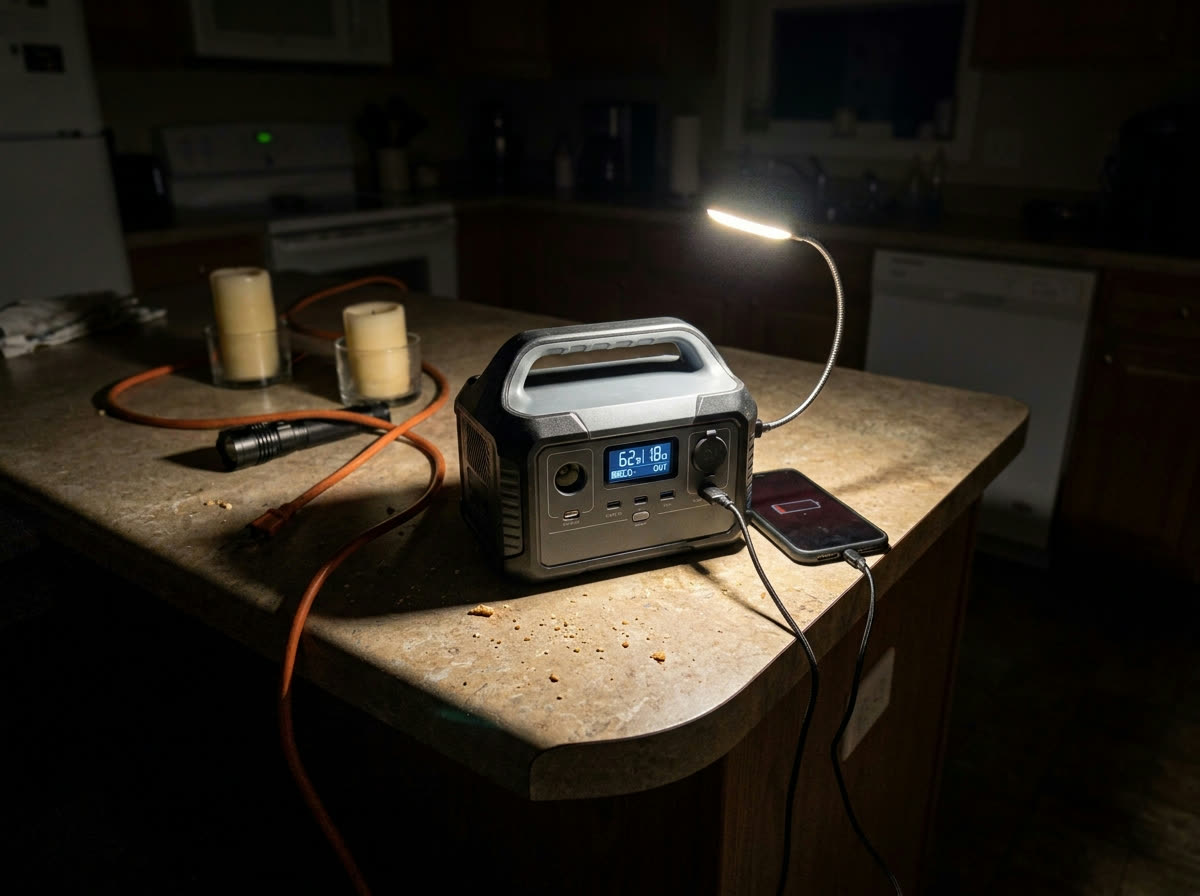
The plan was simple: flip off the main breaker on a Sunday morning and live for seven days as if the grid were down. No cheating with a quick reconnect to brew coffee, no running an extension cord to the neighbor's outlet. We wanted to know, in our own house, with our own stuff, what backup power actually feels like when you have to ration it, recharge it, and listen to it run at 2 a.m.
We tested two approaches side by side. The first was a large lithium portable power station rated around 2,000 watt-hours, paired with a 200-watt foldable solar array. The second was a dual-fuel inverter generator that runs on either gasoline or propane. Going in, we assumed the generator would be the obvious winner on raw capability and the battery would be the quiet, convenient toy. The week complicated that story in ways we didn't expect.
A note before we go further: we are a family of four in a moderate climate, and our goal was never to keep the whole house humming. It was to keep the essentials alive—refrigerator, a CPAP machine, phones, a couple of lights, and the internet router—through a realistic multi-day outage. We deliberately left central air conditioning off the table, and you should too. More on why that math doesn't work below.
What we were actually trying to power
Before the test, we walked the house with a small plug-in watt meter and wrote down what each essential device pulls. This is the single most useful thing we did, and it took about twenty minutes. If you do nothing else from this article, do this.
Here's what we found we genuinely needed to keep running:
- Refrigerator/freezer: roughly 100–150 watts while the compressor runs, but it only runs part of the time, averaging maybe 1–2 kWh over a full day.
- CPAP machine: around 30–60 watts on average without the heated humidifier (which can triple that—turn it off on backup power).
- Internet router and modem: a modest 10–20 watts, but worth its weight in gold for news, work, and keeping kids sane.
- Phones and a tablet: a trickle, a few watt-hours each to top off.
- A couple of LED lights: 10–20 watts total.
Add it up and our true essential load was surprisingly small—on the order of 2 to 3 kilowatt-hours per day. The key insight is the difference between watts (how hard a device pushes at any instant) and watt-hours (how much it consumes over time). A 150-watt fridge that only cycles on for a third of the day isn't a 150-watt-hours problem; it's closer to 1,200 watt-hours. Plain-language version: think of watts as the speed and watt-hours as the distance.
The battery-and-solar station: quiet, clean, and surprisingly capable
For the first three days we ran on the 2,000-watt-hour station alone. It lived in the kitchen, silent, with the fridge, router, and a light plugged in. The CPAP ran off it overnight. There is something genuinely uncanny about backup power that makes zero noise, produces no fumes, and can sit on your countertop indoors with no safety concern at all.
The first night, my wife whispered across the dark kitchen, "Wait—is it actually on?" The little screen glowed, the fridge hummed, and the CPAP hissed steadily down the hall. No engine, no smell, nothing. It felt less like roughing it and more like the house had simply gone quiet.
On a clean 2,000-watt-hour battery, our 2–3 kWh daily essential load meant the station would drain in roughly a day if we did nothing to refill it. That's where the solar came in. On the two genuinely sunny days, the 200-watt array put back a meaningful chunk—realistically 600 to 900 watt-hours over the course of the day, not the full theoretical 200 watts times eight hours. Panels rarely hit their rated number; angle, clouds, heat, and the sun's arc all skim off the top.
Honest caveat: on our one fully overcast day, the panels produced almost nothing—we saw a trickle that wouldn't have charged a phone meaningfully. Solar is a fantastic supplement and a poor guarantee. If your outage coincides with a storm front (and outages love storm fronts), plan for the sun to be unavailable exactly when you need it.
A large lithium power station (around 2,000 watt-hours)
Silent, indoor-safe, zero fumes, and effortless to live with. Excellent for the small, sensitive loads—CPAP, router, phones—that you want running all night without a thought. The ceiling is the battery itself: once it's empty, you're waiting on the sun or a wall outlet that may not exist.
A 100-to-200-watt portable solar panel
The only practical way to extend a battery during a multi-day outage. Worth having, but treat its output as a bonus, not a budget. Two clear days carried us; one gray day did not.
The dual-fuel inverter generator: power on demand, with strings attached
For the back half of the week we leaned on the dual-fuel inverter generator. The contrast was immediate. This thing does not run out at midnight—as long as you feed it fuel, it makes power, and plenty of it. It refilled the battery station in a couple of hours, ran the fridge directly, and could have handled far more than our modest essentials.
The inverter design matters here: it produces clean, stable power that's safe for sensitive electronics like the CPAP and router, and it throttles its engine down to match the load, which saves fuel and cuts noise considerably compared to an old-school open-frame generator.
CRITICAL SAFETY—read this twice: a gas or propane generator must NEVER be run indoors, in a garage, in a shed, on a covered porch, or anywhere near an open window—not even "just for a few minutes," not even with the garage door open. These engines produce carbon monoxide, an invisible, odorless gas that kills people in their sleep every single year during outages. Run it outside, well away from the house, with the exhaust pointed away from any door or window. We also kept a battery-powered carbon monoxide alarm inside as a backstop. There is no acceptable shortcut here, ever.
Honest caveat: the generator was loud. Even the quieter inverter type was a constant drone we noticed indoors and certainly would have annoyed close neighbors at night. It also smelled of exhaust when we stood near it, and it demanded fuel—we went through several gallons over the days we leaned on it.
A dual-fuel inverter generator
The capability heavyweight: near-unlimited runtime on stored fuel, clean inverter power, and the flexibility to run on gasoline or propane depending on what you can get. The trade-offs are noise, fumes, fuel logistics, and the absolute, non-negotiable rule that it stays outdoors.
Fuel storage and the things nobody mentions
The generator's biggest hidden cost is fuel discipline. Gasoline goes stale in a few months and should be treated with a stabilizer and rotated; storing more than a few cans safely (outside the house, away from ignition sources, in approved containers) is its own small project. Propane, by contrast, stores for years without degrading, which is a real argument for the dual-fuel option—we kept a couple of standard tanks on hand and rotated them through the grill.
Honest caveat: propane delivers slightly less power than gasoline in these engines and tanks can be hard to refill in a regional emergency when everyone wants them. Neither fuel is a perfect answer; having both available is the quiet advantage of dual-fuel.
The central AC question, answered plainly
We promised to explain why we left central air conditioning off. A central AC unit can pull 3,000 to 5,000 watts while running, and far more in the surge when the compressor kicks on. That single load can exceed what a portable station or a modest generator can deliver, and even if it didn't, it would devour a 2,000-watt-hour battery in well under an hour. For a multi-day outage, cooling the whole house simply isn't on the menu with portable backup. A single window AC unit or a few fans is a realistic stretch goal; central air is not. Plan around staying safe and comfortable in one room, not conditioning the entire house.
What we'd actually do: a layered approach
After a week, we didn't crown a single winner—because the right answer is both, in layers. The silent battery station is your everyday, all-night, indoor-safe foundation for the sensitive small loads. The dual-fuel generator is your refill station and heavy-lifter, run outdoors in short bursts to top off the battery and chill the fridge. Solar is the bonus that stretches your runway when the sky cooperates. Each one covers the other's weakness: the battery is quiet but finite, the generator is endless but loud and fume-bound, and solar is free but unreliable.
If we had to start with one piece, we'd start with the battery station and a panel—it's the thing you'll actually use, safely, indoors, the moment the lights flicker. Then we'd add the generator as the muscle for longer events. Seven days in the dark taught us that backup power isn't about one perfect machine; it's about a small, honest system you understand well enough to run calmly when it matters. Map your watt-hours, respect the carbon monoxide rule without exception, and you'll spend the next outage a lot more bored than scared—which is exactly the goal.