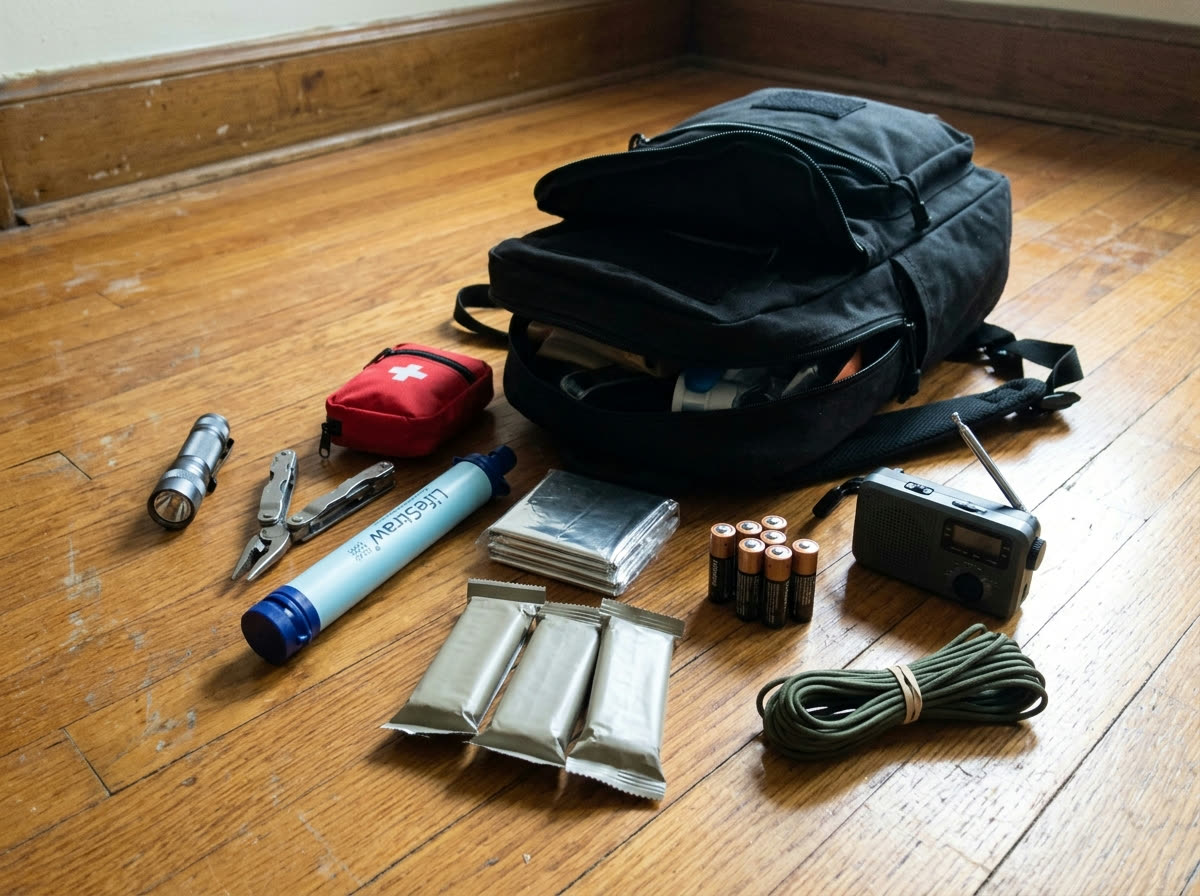
A year ago we packed a 72-hour go-bag, set it by the back door, and made ourselves a quiet promise: we would actually use it. Not stage a photo of it. Not let it become a dusty shrine to a weekend of good intentions. We carried it on shakedown hikes, grabbed it during a two-day power outage, and twice slept a night out of it just to see what we'd forgotten. The bag that came out the other end is noticeably lighter and a lot more honest than the one we started with.
Here's the thing nobody tells you when you're packing: the first version is always too heavy, and it's always heavy in the wrong places. We started around 28 pounds, convinced every ounce was essential. By month four we'd cut nearly nine pounds, and the bag got more useful, not less, because we could actually carry it without dreading it. A bag you resent is a bag you leave behind.
So this is the audit. Category by category, the gear that earned its spot, the gear that got cut, and the unglamorous discipline that keeps the whole thing current instead of expired.
How we organized it: grab-and-go, by the door
The single best decision we made was committing to one bag, one spot. It lives on a hook by the door we'd actually leave through in a hurry, not buried in a closet behind the holiday bins. We can put hands on it in the dark in under five seconds, and that matters more than any individual item inside it.
Inside, we organized by category into color-coded pouches so we're not dumping everything onto the floor to find one thing. Water, light, first-aid, warmth, tools, documents, and a small comfort kit each got their own zip pouch. The first-aid pouch is red, the documents pouch is a waterproof zip bag, and the rest we just learned by feel. When you're stressed, a system you can run by touch beats a system you have to think about.
The categories that earned their weight
These are the survivors. Each one stayed because we used it, or because the consequence of not having it was genuinely serious.
Water: a filter beat hoarding bottles
We started with a brick of bottled water that ate weight and space. It got cut. What stayed was a small straw-style water filter plus a collapsible bottle and two or three single-use water pouches for the first few hours before we'd need to filter anything. The filter weighs a few ounces and turns almost any sketchy water source into something drinkable, which is a far better bet over 72 hours than three pounds of bottles you'll drink in an afternoon.
Honest caveat: straw filters don't remove viruses or chemical contamination, only bacteria and protozoa, and they can freeze and crack if you store the bag in a cold garage and don't dry them out. We keep a few water-purification tablets as a backup for that gap, and we bring the filter inside when temperatures drop.
Light: a headlamp, and then a backup
A headlamp earned its spot the first power outage. Hands-free light is the difference between fumbling and functioning. We added a tiny hand-crank flashlight as a no-batteries backup. What got cut: the big tactical flashlight that was heavy, drained batteries fast, and did nothing the headlamp couldn't.
First-aid: a real kit, plus the boring stuff that gets used
Most pre-made kits are mostly bandages. Useful, but the items we actually reached for were the unsexy ones: blister care, pain reliever, any personal prescriptions, electrolyte packets, and a roll of medical tape that does forty jobs. We built around a compact first-aid kit and added those.
- Assorted adhesive bandages and a couple of larger gauze pads
- Blister cushions — used more than anything else on our shakedown hikes
- Pain/fever reliever and any allergy medication
- A few days of personal prescription medication, rotated so it never expires
- Medical tape, tweezers, and a handful of electrolyte packets
Honest caveat: a kit is not training. We keep the contents modest on purpose, because gear you don't know how to use can give false confidence. A basic first-aid course taught us more than any deluxe kit ever could, and it's worth more than the upgrade. For anything beyond minor injuries, the plan is still to get to professional care.
Warmth: the emergency blanket that stays, the sleeping bag that didn't
Warmth is where people under-pack and then get genuinely cold. A couple of mylar emergency blankets and a compact emergency bivvy stayed. They weigh almost nothing and trap a startling amount of heat. A dry pair of wool socks and a watch cap stayed too — small, cheap, and a real morale boost when everything else is damp.
Honest caveat: thin mylar blankets are loud, tear easily, and are basically single-use. They're a stopgap, not a real shelter. The bulky sleeping bag we started with got cut for weight; for a 72-hour bag the bivvy-plus-layers combination was the better trade, though we'd think differently in deep-winter country.
Tools: a multi-tool, cordage, and a way to make fire
A multi-tool with pliers earned its spot daily — it's the item we'd replace first if we lost it. A small length of paracord, a roll of duct tape wrapped around a card, and two independent ways to start a fire (a lighter and a ferro rod) rounded it out. A hand-crank NOAA weather radio with a USB charging port also stayed; during the outage it was our only line to what was actually happening, and it topped up a phone in a pinch.
The night the storm knocked the grid out, we sat at the kitchen table cranking that little radio while the rain hammered the windows. The robotic NOAA voice reading off county names felt absurdly comforting — it was the first solid information we'd had in hours, and it told us the worst had already passed over us. We slept better for it.
Honest caveat: hand-crank radios charge a phone slowly — minutes of cranking for a few percent. Treat it as emergency-only, not your real charging plan. We added a small power bank for that, and keep it topped off.
Documents and cash: the category everyone forgets
This one is dull and possibly the most important. A waterproof pouch holds copies of IDs, insurance and medical info, emergency contacts written on paper, and a modest amount of small-bill cash. When the power's out, card readers are out too. We learned to keep the contact list on paper because a dead phone is a useless address book.
The comfort items that surprised us
We almost cut these as frivolous. We're glad we didn't. A few hard candies, a paperback, and — for the household with kids — one small familiar toy do real work for morale when you're stuck and anxious. Stress is a survival factor too, and a five-cent piece of candy can reset a bad moment. The discipline is keeping comfort items small: they earn their place precisely because they're light.
Keeping it current: the part most bags fail
A go-bag isn't a one-time project; it's a small recurring chore. Twice a year, at the time-change weekends so we don't forget, we do a full pull-out: rotate the medications and snacks before they expire, test the lights and radio, re-dry the filter, swap seasonal clothing layers, and update the documents if anything changed. Most failed go-bags don't fail because of bad gear — they fail because the batteries died in 2023 and nobody checked.
A few common-sense safety notes from the year: store the bag somewhere temperature-stable if you can, because heat and freezing both wreck batteries, medications, and filters. Keep anything sharp sheathed and stored sensibly, especially in a household with kids. And practice grabbing the bag and walking out — a calm dry run beats a frantic real one.
After a year, the bag we trust is lighter, simpler, and a little scuffed. Almost nothing in it is fancy; most of it is cheap, boring, and proven. That's the real lesson. The go-bag that earns its spot isn't the one with the most gear — it's the one you'll actually carry, that actually works when you open it, because you've opened it before. Start with one bag by one door, carry it, live out of it once, and let the year tell you what to cut.