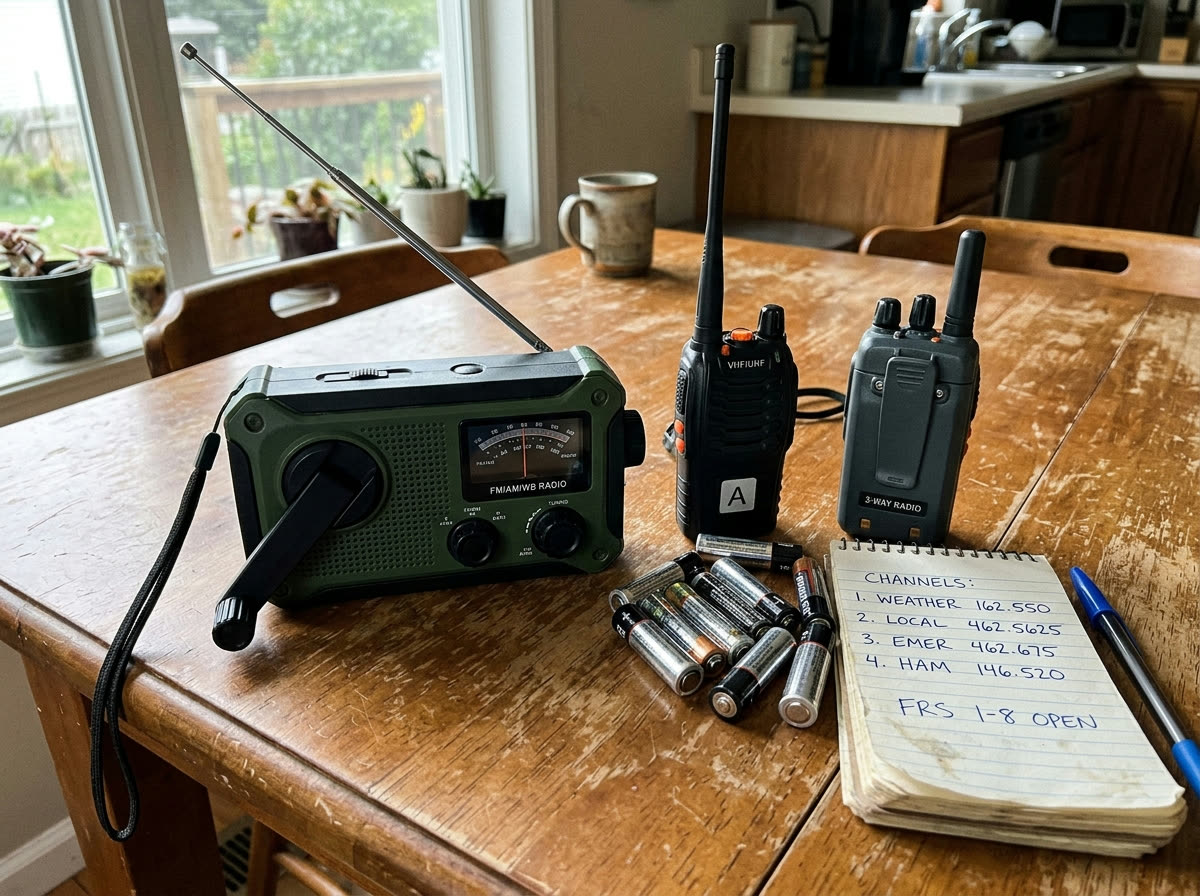
The first thing that fails in a real emergency is usually the thing everyone reaches for first: the phone in their pocket. Not because the device breaks, but because the network behind it quietly buckles under the weight of an entire region trying to call, text, and check on family at the same moment. We have watched it happen in storms, in wildfire evacuations, and during a multi-day regional power outage, and the pattern is always the same. Bars on the screen, but nothing goes through.
So we spent time with the communication gear that keeps working when the towers don't: weather radios that pull alerts out of the air, small handheld two-way radios for keeping a family connected across a neighborhood, and the unglamorous paperwork that ties it all together. None of it is exotic. Most of it is cheap. But there is a real gap between what the box promises and what actually happens when you're standing in a parking lot trying to reach someone two streets over.
This is the honest version of what we learned, including the parts that disappointed us.
Why your phone stops working before anything looks broken
Cellular networks are designed for everyday load, not for everyone-at-once load. When a disaster hits, two things happen together. First, call and data volume spikes far past normal capacity, so the network congests and your texts queue, your calls drop, and your data crawls. Second, the towers themselves run on grid power with limited battery backup. After a few hours of an outage, batteries drain and backup generators run dry, and individual sites simply go dark.
The cruel part is that congestion and power loss compound each other. As some towers fail, the survivors absorb even more traffic and congest faster. This is why a fully charged phone showing signal can still be useless. The problem isn't your battery; it's the system on the other end.
The lesson we kept relearning: don't plan to communicate through the network in a disaster. Plan to communicate around it, and treat any working cell service as a lucky bonus rather than the foundation.
Receiving alerts: a weather radio earns its place
Before you talk to anyone, you need to know what's happening. That's the job of a dedicated weather radio, and it's the single piece of gear we'd buy first.
A hand-crank NOAA weather radio
A hand-crank NOAA weather radio receives broadcasts from government transmitters covering most of the country, including the automated alerts that come through even when local broadcast TV and radio are off the air. The models we like combine a hand crank, a small solar panel, and a rechargeable battery, so you're never fully dependent on wall power. Many also include a USB port to trickle-charge a phone and a built-in flashlight, which makes the radio do triple duty in a kit.
The feature that matters most is the alert function. Leave it in standby and it stays silent until the transmitter sends a watch or warning for your area, then it sounds. That's how you get woken up by a tornado warning at 3 a.m. when your phone is dead.
Honest caveat: hand cranks are for topping off, not for serious charging. A minute of frantic cranking buys you a short burst of radio time or a sliver of phone battery, not a full charge. Treat the crank as your last resort and keep the radio charged from a wall outlet between emergencies.
Talking to your own family: handheld two-way radios
Once you can receive information, the next problem is reaching the people you love when texts won't send. This is where small handheld two-way radios shine, and also where the marketing gets the most dishonest.
A pair of FRS/GMRS handheld two-way radios
These are the compact radios sold in pairs, often blister-packed with a charging cradle. They operate on shared public channels and require no infrastructure at all. Two radios talk directly to each other, which is exactly what you want when the towers are down. For a family staying within a neighborhood, coordinating an evacuation, or keeping in touch between a house and a nearby relative, they're genuinely useful.
Honest caveat: ignore the range number on the box. When a package claims 25 or 36 miles, that figure assumes two people standing on separate mountaintops with nothing in between. In the real world, these radios are limited by line of sight. In a suburban neighborhood with houses, trees, and a few hills between you, realistic reliable range is often under a mile. Inside dense areas or across town, expect less. We tested several pairs and were lucky to hold a clear conversation past a half-mile in typical residential terrain.
That isn't a reason to skip them. It's a reason to plan around their actual range:
- Use them for keeping a group together during an evacuation, not for cross-city contact.
- Agree on a primary channel and a backup channel in advance, written down.
- Get to higher ground for a transmission when you can; elevation helps more than wattage.
- Keep transmissions short and clear, and confirm you were heard rather than assuming.
- Buy a set with removable AA batteries as a fallback, so you're not stuck with only a proprietary pack.
A quick word on the license
The more powerful GMRS channels and the higher-wattage radios that use them require an inexpensive FCC license. The good news: there is no exam. You apply, pay a modest fee, and the license covers your whole immediate family for ten years. The lower-power FRS channels on the same radios need no license at all, so you can use the device legally out of the box and add the license when you want the extra range. We think the license is worth it, but we mention it simply so there are no surprises.
The plan that ties it together
The best radio in the world is useless if your family hasn't agreed on how and when to use it. The cheapest, most effective piece of preparedness here costs nothing: a written communication plan.
The out-of-area contact
Pick one relative or friend who lives far enough away that they're unlikely to be affected by the same disaster, and make them everyone's check-in point. Here's the counterintuitive part: in a regional outage, a long-distance call or text often goes through when a local one won't, because local circuits are saturated while distant ones aren't. Everyone in the family calls or texts the out-of-area contact to report they're safe, and that one person becomes the hub that relays everyone's status.
Physical meeting points
Decide in advance on two meeting places: one just outside your home (for a house fire or quick evacuation) and one outside your neighborhood (in case you can't get home at all). Write down the exact addresses. When no one's phone works, a meeting point is how a family reassembles.
Honest caveat: a plan you made once and never practiced is barely a plan. Run it twice a year. Have everyone actually call the out-of-area contact, actually meet at the spot, actually power on the radios and find each other on the agreed channel. The first time we did this, we discovered our chosen channel was full of someone else's chatter and our backup wasn't written down anywhere. Better to find that out on a calm Sunday.
Power: the quiet thing that decides everything
Every device above is only as good as the energy behind it. In a multi-day outage, charging becomes the constraint that quietly governs all your communication.
We keep a battery power bank for each family member, charged and stored full, sized large enough to refill a phone two or three times. We rotate them every few months so they're never sitting empty. Beyond that, a small folding solar panel that can refill the power banks during daylight turns a finite supply into a renewable one, and the hand-crank weather radio's USB port is a genuine last-ditch source.
Honest caveat: a power bank you forgot to charge is just a paperweight. The most common failure we see isn't buying the wrong gear; it's buying the right gear and storing it dead. Pick a recurring date, the same day you test your radios, and top everything off.
What we'd actually do
If you do nothing else, do this. Buy one hand-crank NOAA weather radio and learn to set its alerts. Buy one pair of handheld two-way radios, test their real range in your own neighborhood, and decide on your channels. Write a one-page communication plan with an out-of-area contact and two meeting points, print copies, and put one in every wallet and glovebox. Keep a charged power bank per person and a date on the calendar to test it all.
None of this is expensive, and none of it depends on the cell network surviving. That's the entire point. When the towers go quiet, the families who stay connected aren't the ones with the best phones. They're the ones who, on some ordinary afternoon long before the storm, sat down and made a plan that didn't need a signal.