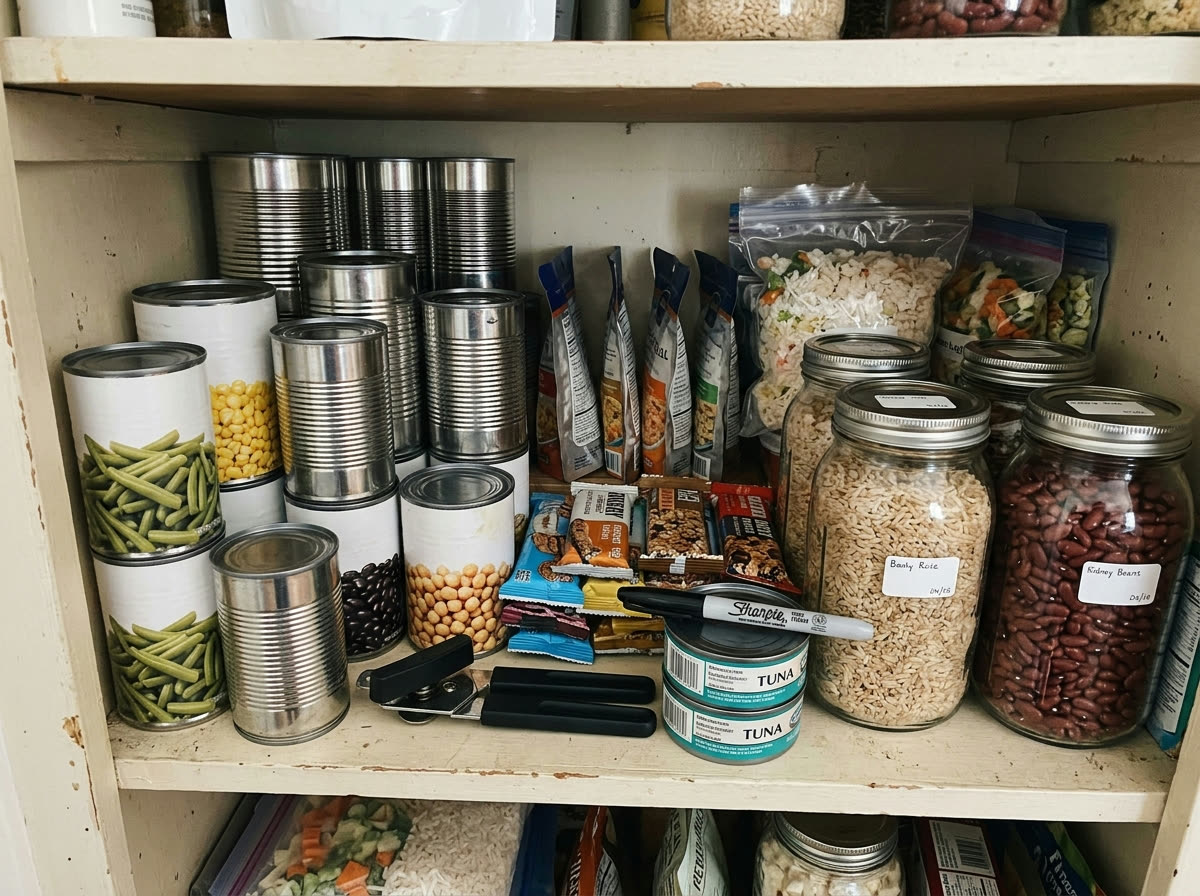
The most common mistake we see with emergency food is also the most expensive one: buying a sealed bucket of meals you will never open, shoving it in a closet, and forgetting it until the "best by" date has long passed. We have done it. The bucket sat there for four years, we eventually cracked it during a long power outage, and discovered we did not actually like the food. That is a bad moment to learn that.
So we changed our whole approach. The 72-hour supply we keep now is built almost entirely from food we already buy, already eat, and actively cook through. Nothing is special. Nothing is precious. The whole point is that it moves.
This is the "store what you eat, eat what you store" philosophy, and once it clicks, emergency food stops being a separate chore and just becomes how you grocery shop.
Start with the math, not the products
Before buying anything, do the arithmetic. The working number we use is roughly 2,000 calories per person, per day. It is a planning figure, not a precise nutritional prescription, but it keeps you honest. A "three-day supply" that quietly delivers 900 calories a day is not a three-day supply; it is a hunger experiment.
For 72 hours, that means about 6,000 calories per person. A household of four needs roughly 24,000 calories on the shelf to cover three days. Write that target down, because it reframes everything. A few cans of soup at 250 calories each suddenly look very small against the goal.
Honest caveat: calorie-dense does not mean nutritious. A supply built entirely on crackers and peanut butter will keep you upright but feeling rough by day three. We aim for a mix of protein, fat, and carbohydrate, and we treat the calorie target as the floor, not the whole plan.
What we actually keep (and why it's all stuff we eat)
Everything below is food that rotates through our normal meals. If a hurricane never comes, none of it goes to waste, because it was always destined for a regular Tuesday dinner.
Canned proteins
Canned tuna, chicken, salmon, beans, and chili do a lot of heavy lifting. They are calorie-reasonable, shelf-stable for years, and edible straight from the can if needed. We keep a steady backstock and cook from the oldest cans first.
Shelf-stable carbohydrates
Rice, pasta, instant potatoes, oats, crackers, and tortillas. These are cheap calories and the backbone of any real meal. Honest caveat: dry rice and pasta need water and heat to be useful, so they belong in your "cook" column, not your no-cook emergency tier.
Pouched and freeze-dried meals
We do keep a small number of pouched freeze-dried meals and shelf-stable ready-to-eat pouches for convenience and very long shelf life. They are genuinely handy. We just refuse to make them the entire plan, because they are expensive and, as we learned, easy to dislike when you finally taste them.
Fats and calorie boosters
Peanut butter, nut butters, cooking oil, and shelf-stable nuts pack the most calories per ounce of anything in the pantry. A jar of peanut butter alone can carry several thousand calories. These quietly make your day-piles add up.
Comfort and morale foods
Instant coffee, tea, cocoa, hard candy, cookies, a familiar snack the kids love. This is not filler. When the power is out and everyone is anxious, a hot drink and a normal-tasting treat do real work.
During one multi-day outage, the thing that settled our youngest down was not the carefully calorie-counted dinner. It was a cup of cocoa made on the camp stove, exactly like a normal night. Morale is a supply you also have to stock.
The rotation system: dating, FIFO, and never buying a "prepper closet"
This is the part that makes the whole thing non-wasteful. We do not have a separate emergency stash. We have a slightly deeper version of our normal pantry, and we rotate through it constantly.
The system is boring on purpose:
- Date everything with a marker. When groceries come in, we write the purchase month on the lid or label in big numbers. The printed "best by" date is small and easy to ignore; a fat marker date is not.
- FIFO: first in, first out. New cans go to the back, older cans come to the front. We cook from the front. This single habit means nothing quietly ages into the trash.
- Buy one to use, one to store. When we open the last backup of something, that is the cue to buy two next trip. The shelf refills itself.
- Check the front row monthly. A two-minute glance at what is up front tells us what to cook this week.
Honest caveat: "shelf life" is not a hard expiration cliff for most of these foods. Canned goods are typically fine well past their printed date if the can is intact and not bulging, dented at the seam, or rusted. But we do not push it on a guess, and we do not eat from a can that looks or smells wrong. When in doubt, we throw it out.
No-cook vs. cook: plan for the worse case
The hard scenario is the one where the power and gas are both out. So we split the supply mentally into two columns.
The no-cook tier is everything edible with zero heat: canned proteins, beans, fruit, crackers, peanut butter, nuts, granola bars, ready-to-eat pouches, jerky. This tier alone should comfortably cover the full 72 hours. If it does, you are genuinely prepared even in the worst case.
The cook tier (rice, pasta, dried beans, oats, freeze-dried meals) is the upgrade you reach for when you have a camp stove, grill, or working burner. It stretches your supply much further per dollar, but it depends on heat and water, so it can never be your only plan.
Honest caveat: never run a camp stove, grill, or generator indoors or in a closed garage. Cooking gear is for outdoors or a well-ventilated space, full stop. We are not offering medical advice here, but carbon monoxide is a documented danger and the rule is simple: combustion stays outside.
Scaling from 72 hours to two weeks
Once the three-day supply is solid and rotating, scaling up is mostly multiplication, not reinvention. Two weeks for one person is roughly 28,000 calories at our planning number; for a family of four, around 112,000.
The good news is that the rotation habit does the work. To go from three days to fourteen, we simply deepened the backstock of the same foods we already cook with, leaning harder on the cheapest dense calories: rice, pasta, oats, beans, oil, and peanut butter. We added a few more freeze-dried meals for variety on the long end, and we made sure water and a heat source scaled too, because a two-week supply of dry goods is useless without both.
Honest caveat: two weeks of food also means two weeks of dishes, trash, and morale management. Paper plates, extra trash bags, dish soap, and a few more comfort foods are easy to forget and genuinely matter when the stretch gets long.
The 72-hour supply we actually rotate through is not impressive to look at. It is a normal pantry, slightly deeper, dated with a marker, eaten from the front, and refilled from the back. But it has two things the forgotten bucket never had: we know we like the food, and we know it is fresh, because we are eating it all the time.
Start with the calorie math, build a no-cook tier that covers all three days, keep a manual can opener within reach, and let "store what you eat, eat what you store" turn preparedness from a chore into a habit. When you are ready, deepen the same shelves toward two weeks. The system stays the same. Only the depth changes.